Cloud Computing Security Automation What is Cloud Workload Security November 10, 2025 / December 15, 2025 by Maria A. | Leave a Comment Cloud computing changed how we deliver software. We deploy faster, scale elastically, and pay only for what we use. The tradeoff is that every virtual machine, container, Kubernetes pod, and function you spin up becomes a “workload” that must be secured from build to runtime. Cloud Workload Security (CWS) is the set of practices and […] Read more »
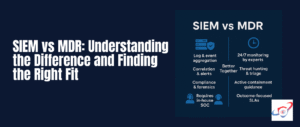
Cyber Security Security Automation SIEM vs MDR: Understanding the Difference and Finding the Right Fit November 5, 2025 / December 15, 2025 by Maria A. | Leave a Comment In the ever-evolving world of cybersecurity, businesses face a relentless stream of threats. From ransomware and phishing attacks to insider abuse and supply-chain compromises, the risks are multiplying in both scale and sophistication. Yet, amid this chaos, one question constantly arises: how should organizations structure their detection and response capabilities? Two prominent answers have emerged […] Read more »
Cloud Computing Security Automation Real-Time Configuration Drift Detection Capabilities: Closing the Gap Between Intended and Actual State October 30, 2025 / December 15, 2025 by Maria A. | Leave a Comment The Hidden Threat of Configuration Drift In modern cloud and DevOps environments, systems evolve at a rapid pace. Teams deploy code multiple times a day, infrastructure is automated through code, and configurations change dynamically through continuous delivery pipelines. Amid this constant motion, one silent but costly threat looms large — configuration drift. Configuration drift occurs […] Read more »
Security Automation How to Prevent Viruses and Malicious Code October 29, 2025 / November 5, 2025 by Maria A. | Leave a Comment Why prevention still matters (even in 2025) How to prevent viruses and malicious code: Malware isn’t just “viruses” anymore. It’s ransomware that locks your data, info-stealers that empty accounts, worms that move laterally, supply-chain implants that hitchhike in dependencies, and scripts that turn your machines into botnets. Most attacks succeed not because they’re clever but […] Read more »
AI Security Security Automation Kubernetes Runtime Security: Protecting Modern Containerized Workloads October 1, 2025 / October 1, 2025 by Maria A. | Leave a Comment Kubernetes is now the most common way to manage containerized apps. It automates the deployment, scaling, and management of workloads, which makes it a key part of modern cloud-native setups. But with tremendous power comes a lot of work, and with a lot of work comes peril. You can't just think about security in Kubernetes later. Network policies, RBAC (Role-Based Access Control), and secure configurations are all good ways to stop problems before they happen. Runtime security is the last line of defense. Read more »
AI Security Security Automation SOC Agent: Next Evolution of Security Operations September 24, 2025 / September 24, 2025 by Maria A. | Leave a Comment A SOC agent is an AI-powered software worker that performs day-to-day Security Operations Center tasks—triage, enrichment, correlation, ticket updates, and even guided response—by reading data from your tools (SIEM, EDR/XDR, email security, IAM, CSPM), reasoning over it, and taking actions through automations (SOAR, cloud provider APIs, ITSM). Think of it as a junior analyst who never sleeps and learns quickly, paired with strict guardrails so it cannot cause harm. Read more »